
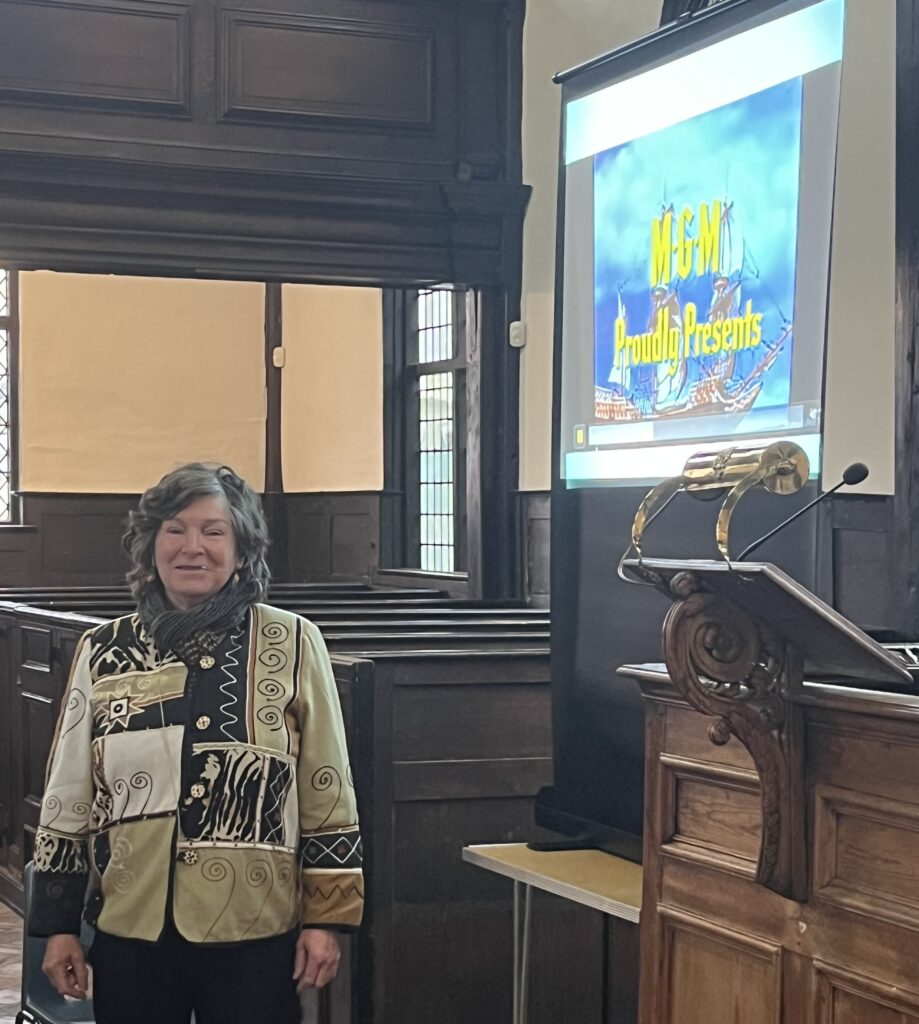
Sunday afternoon 11 January, 2026 found 45 East Coast Gaffers and friends gather in the wooden box pews of the 1700 oak-framed Unitarian Meeting House, Ipswich. The assembled company heard Cathy Shelbourne, from the Ipswich Maritime Trust, describe what we know about the Mayflower’s voyage to America.
A military outpost was established in Roanoke, now North Carolina, by Sir Walter Rayleigh in 1585, later evacuated in 1586. The following year a colony founded by John White disappeared without trace. The first permanent English settlement was at Jamestown in 1607, led by Batholomew Gosnold from Otley Hall, Ipswich. Despite a mixed English settlement history, popular culture has adopted the Mayflower’s voyage of 1620 as a key event in US history. Pilgrims fleeing religious persecution may have favoured support from the church and fitted with later political moves for independence.
Captain Christopher Jones was brought up in Harwich (his restored house is well worth a visit) and his wife came from the Alma Inn across the street. He moved his business to Rotherhithe, where a modern stone marks his grave opposite the Mayflower Public House. His three merchants ships were chartered to take the dissenters from Leiden and London via Southampton and Plymouth. He probably chose Cape Cod for the landing because of his previous experience fishing on the Grand Banks. With so many ‘Mayflower’ ships at that time, the origin of the ship is not known, though the yard may have been in Aldburgh, Ipswich or Harwich.
Report: John Warren
This was a great talk for those interested in the maritime history of the East Coast. Thanks to Cathy and also Jodi Warren for organising and cooking some delightful cakes to go with the tea afterwards. Our thanks also go to the Unitarian Meeting House, Ipswich for hosting this event.
You must be logged in to post a comment.