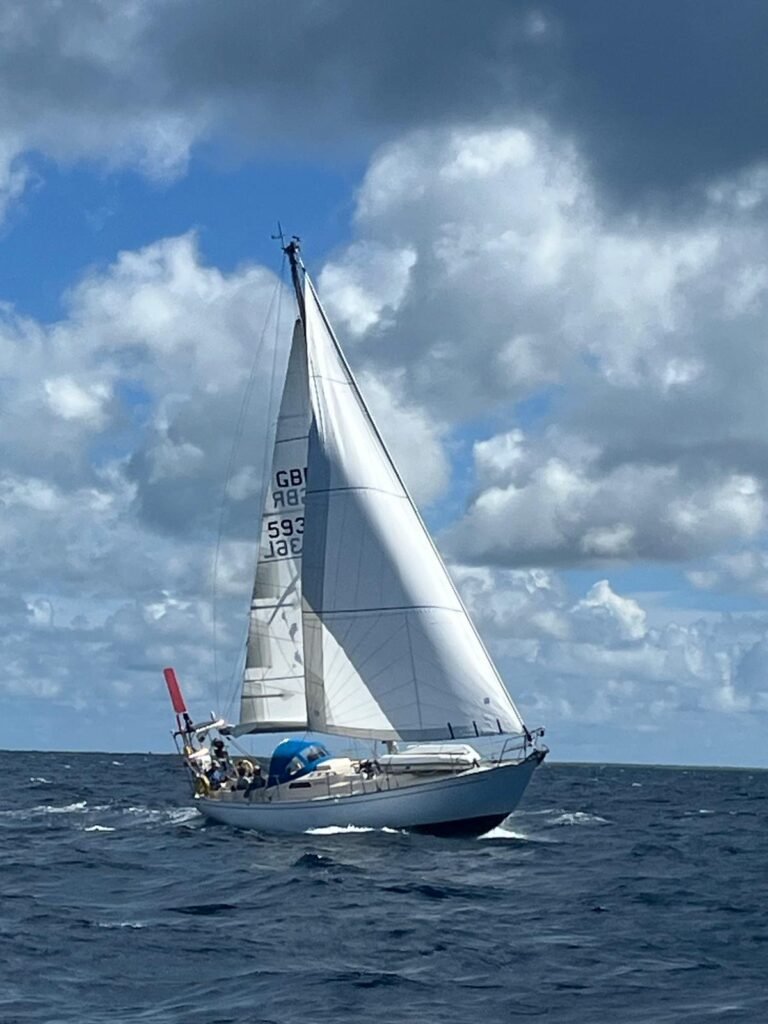
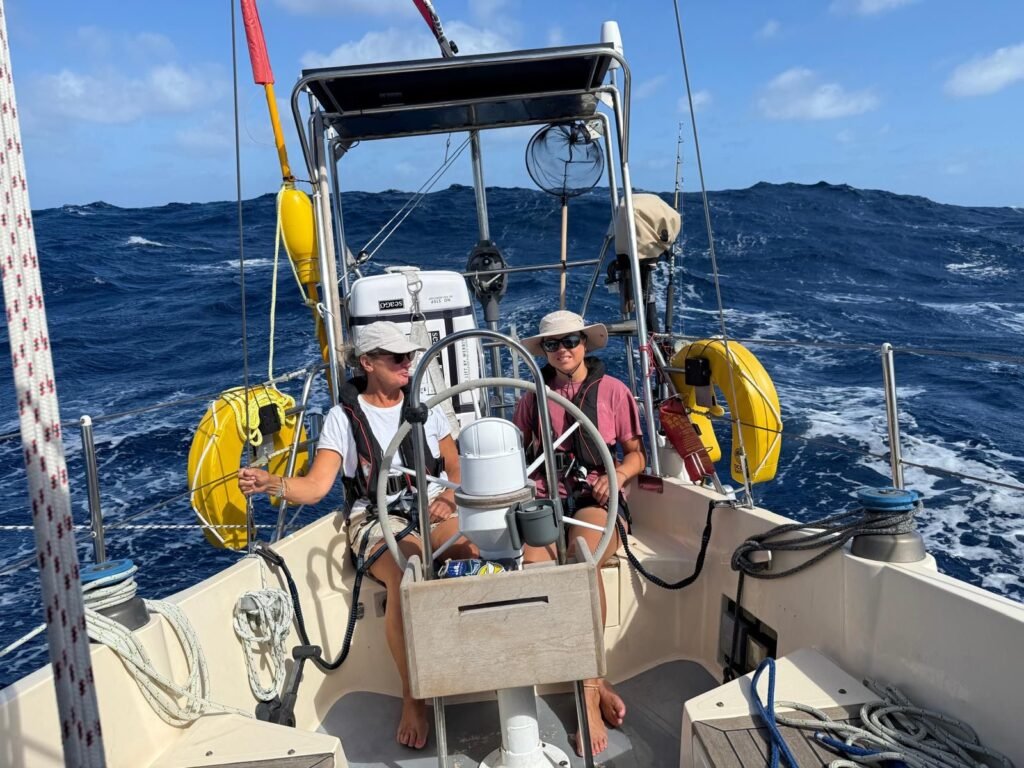
We bring a report from Jo Masters of the transatlantic crossing undertaken by EC OGA President, Paul (Captain) with wife Jo (Author of this report & Crew) and daughter Anna (Crew & experienced transatlantic yachtswoman) Friday 5 – Tuesday 30 December, 2025 in ‘Skybird’ a Biscay 36.
Las Palmas to Barbados. It’s a ‘thing’ to realise one of your ambitions: ‘Sailing across the Atlantic’. At least it is for some people. Others can’t imagine anything worse! As we are in the former category, it’s surprising how many of our friends have also achieved this or at least understand the urge to do it and are full of admiration and support – while keeping their feet firmly on land.
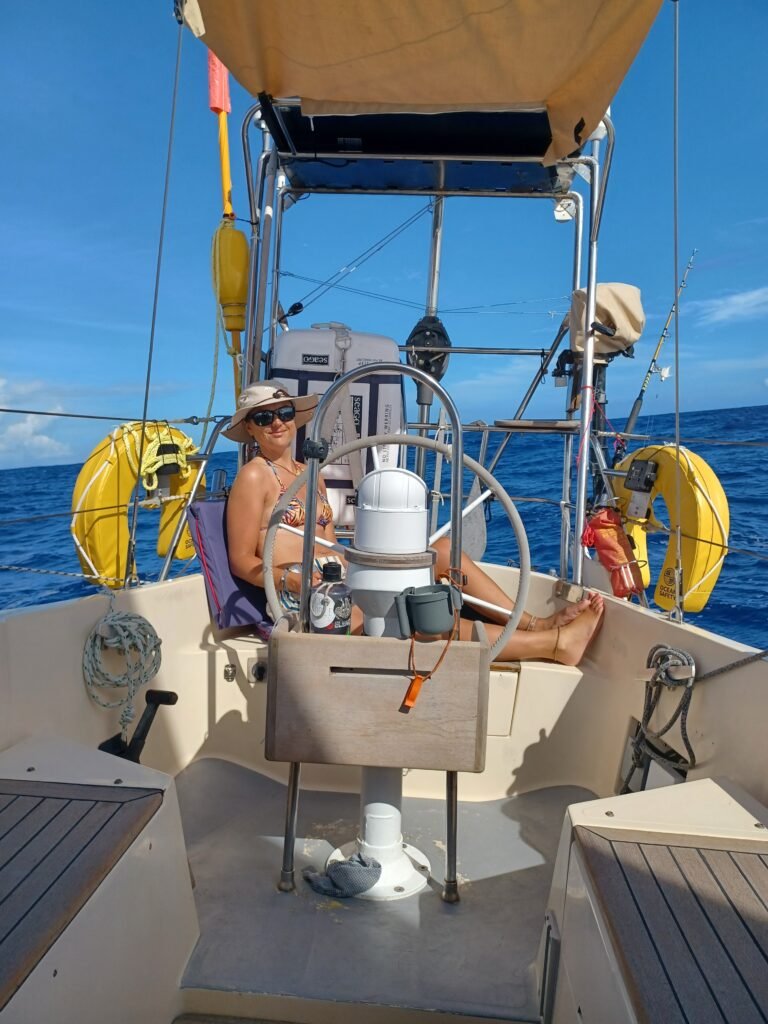
The boat we chose is a Biscay 36 named ‘Skybird’, not the most well-known of vessels but well qualified to look after us, as two competed in, and finished the Golden Globe race in 2023/2024. She is traditional in design so has no double aft cabin or spacious saloon nor ensuite heads, and no guest cabin or a Bimini. However, a long keel and a hydrovane are two of the many ocean-going features she has got. We have sailed as a couple for many years while bringing up our three children, but never more than a two-night passage. So, it was wonderful when our eldest child, Anna, 32, volunteered to help us. Is it cheating that she’s a professional first mate on sailing superyachts? I don’t think so, but she certainly keeps safety forefront in her mind.
We departed Las Palmas de Grand Canaria following a rigging check by Anna, and a frustrating time stocking up via dinghy and being unable to refill our two 6kg Calor propane bottles. We will be heading towards Barbados with the opportunity to call in to Cape Verdes if needed. There was a recent article in the September 2025 ‘Flying Fish’ about superstitions on a boat. We flout several of those by having females and bananas onboard, cutting hair and nails, and now leaving on a Friday. I didn’t care – I just wanted to get going and there was at least one of those I could do nothing about! So, we departed on Friday 5 December, 2025.
The forecast was fair and there was a steady NE air stream. Before making the most of the wind we first we had to motor sail for six hours out of the wind shadow of the islands. We started the watch system straight away – with 3-hour watches during the day, and 2 hour watches at night. Anna had devised it for us, and we had tested it out when the three of us sailed over from Lagos in Portugal to Lanzarote. We picked the wind up 40 miles later and had a wonderful evening sail with the perfect 12 knot wind speed to settle us gently into this long passage, with the help of our hydrovane. Days 2, 3 and 4 resulted in lighter winds, sloppy seas and slatting sails that shook the whole boat in a seemingly unnatural and non-rhythmic motion. We wanted to conserve fuel, so didn’t use the engine. The rolling motion made sleeping difficult along with all those irritating noises that you didn’t realise existed. No doubt you’ll all be familiar with the rattles, creaks, taps and bumps which lead to the midnight ramblings of detection and prevention. A bonus was the full moon all night.
Our friends had suggested we join the Ocean Cruising Club (OCC) and since flying our (associate) flag, I have sought out other members in ports. Brian Wallace was one such member in Lagos and he was an endless supply of anecdotes and sensible answers to my naïve questions. His lasting advice was 1. Don’t buddy sail, sail in company but don’t let another boat rely on you or slow your progress, and 2. Don’t have deadlines. Whenever we are asked if this is our first long passage, a veil of wistfulness appears in their eyes, and they are envious of our experiences yet to come. So, the initial few days and nights are as comfortable as can be expected, while being a human pinball! We found we had to run the engine for a couple of hours a day to keep up with our electricity consumption and were glad we had a hydrovane and not a power-hungry autohelm! Several days in I managed to catch a fish, much to my surprise. It was a mahi mahi but only small one, and with enough food supplies onboard we decided to let it go. Anna also told us that they mate for life. By day 5 the average wind was 12 knots and our SOG was 4-5kn with 1.5m swell from behind. One might think it sounds quite comfortable, but the boat rolls a lot downwind, so activities of daily living were heavily tested.
The night watches provided time for thinking. As we don’t have a sailing Bimini, the view upwards was stars and then later in the night, the moon. I realised my ignorance in recognising the constellations and the associated stories. I do, however, recognise Orion. He appeared on the horizon every evening and gently elevated himself throughout the night, slowly fading on his downward journey with the appearance of the moon. Anna has offered us a masterclass in sextant use (for sun sights), but it will have to be before the end of this year before the tables expire. We found it hard with the big swell and testing living conditions the times we tried out the sextant.
The colour of the water out in the Atlantic, especially in the sun, was beautiful and the glassy steel-blue topped with the snowy white caps of the surf is mesmerising. The bundles of bubbles formed from our wash swirl around below the surface showing how crystal clear the water was. The animals around us were also clearly visible, be they dolphins or fish. It’s a thing of wonder to us – this clean, clear water, coming as we do from the muddy waters of East Anglia. Even rounding the corner of Kent heading towards Ramsgate, we noticed a better clarity of water. The rollers and waves of this passage bewitch me, watching how our little boat rises and wobbles over them. I am one of the lucky ones who doesn’t suffer with sea sickness. I was unprepared for how noisy the water and waves are and the hydrovane rudder also babbles away, noisily, making it difficult to hear much from the crew when sat behind the wheel in the lookout position. The constant noise is an aspect of ocean cruising you can’t escape from and I found it added to my stress levels after several days.
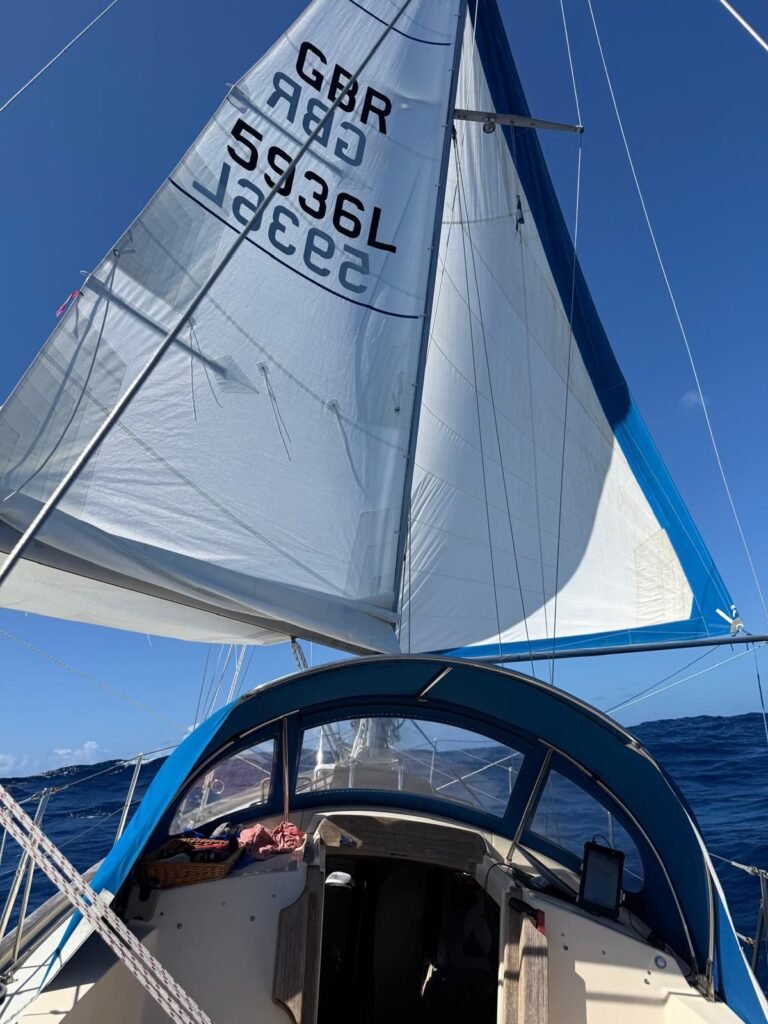
Apart from being muddy and shallow, the North Sea where we are used to sailing, should not be underestimated. Due to its depth, or lack of it, close waves can be kicked up quickly and we have learned to respect this. It does trim our speed as the waves slow us down whereas the Atlantic waves, on the other hand, allow us to maintain our speed. I found it interesting to watch the surf approach our transom, roaring as it did, and subsiding before it reached us. The occasional wave would approach from the beam, hit us and rise up and flop down on the crew, drenching them, amidst roars of surprise and laughter. Our sail plan for the first few days was main and genoa. One reef over-night, which remained in place during the days as well. However, with the slatting sails juddering the boat, it worried us, so we stowed the main and poled out the jib. We were advised to keep our new genoa for island hopping and day sails on arrival to the Caribbean. Our old sail seemed to be a happy work horse and easy to furl with the pole attached, thanks to Anna’s setup advice. Now you might be thinking that we don’t know how to manage our sails very well, but the truth is that we are ‘gaffers’ (gaff rigged-boat sailors) and the drive for these boats comes from the mainsail. So it is with glee that that we find a boat so easily driven with just a headsail.
During our quiet time in the first week, we had to decide if we wanted to run to the Cape Verdes before a week of strong winds or carry on. But the strongest winds would reach us before landfall anyway. Do we approach the CV’s in a gale and seek shelter or do we continue westwards and tough it out? After much discussion, we decided to keep going partly because we didn’t want to approach land in very strong winds. However, the next few days were some never to forget, although we wish we could.
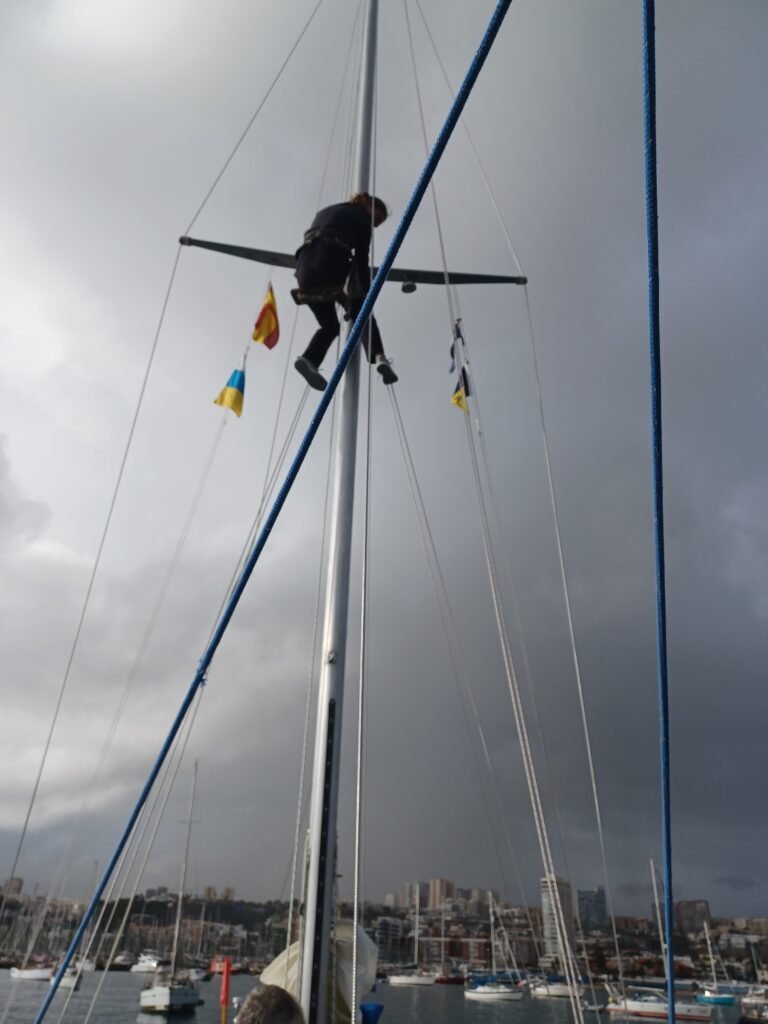

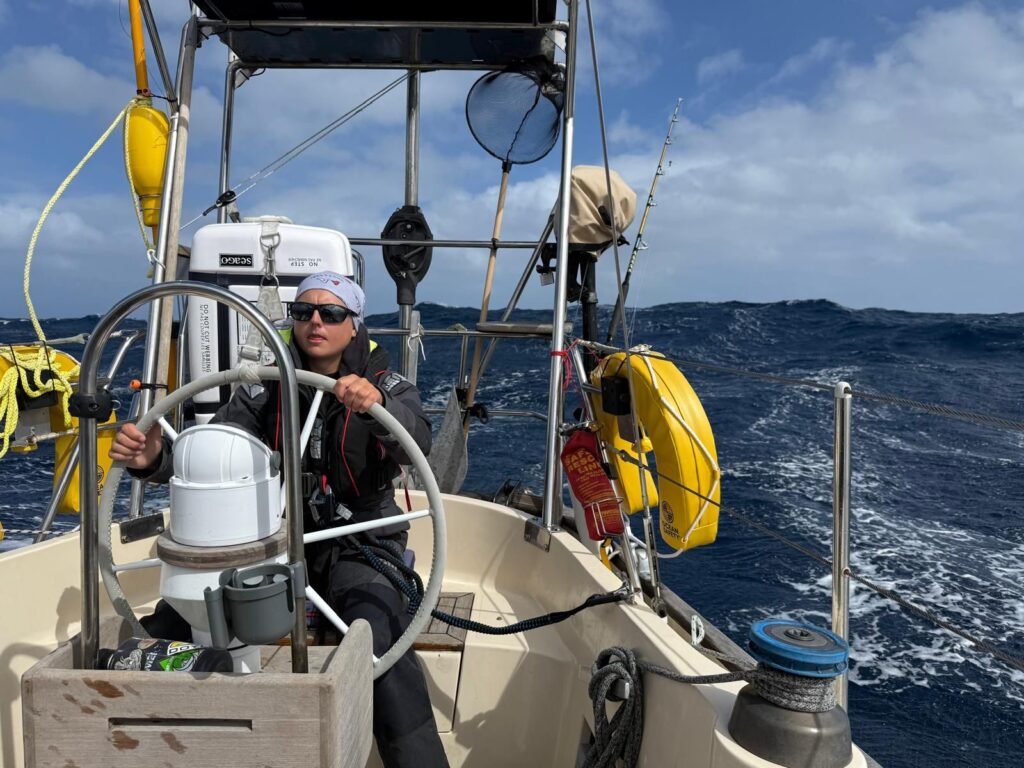
The wind gradually built from a steady 17knots to 25 knots 24 hours later. The first night we reefed the genoa a little more. Then we decided to hand steer in the big waves, but it wasn’t easy. There was more West in our heading, and the sea was following us with a cross swell from the NE resulting in a messy motion! We really got thrown around. Speaking to others who have crossed this year, they experienced the same conditions. Our shift pattern changed to accommodate the worsening conditions, hand steering for two hours, standing-by in the cockpit for two hours and sleeping for two hours, over two days. It was gruelling. There were regular gusts of 30kns and numerous rain showers. When the moon rose, the waves were visible but we weren’t sure whether this was helpful! We had a few rogue waves dumping water into the cockpit but only enough to put a few centimetres over the cockpit floor. The bioluminescence was beautiful, and the shooting stars were impressive but so was a squall one night. The wind was a steady 28kn which rose sharply to 40kn. It was during this squall when Anna was on the helm, Paul was on standby and I was trying to take my 2-hour sleep down below. I woke up with the roar of the waves and the screaming of the wind in the rigging. I haven’t heard that before, but it is the perfect description of that terrifying noise. It took all of Anna’s concentration to keep the boat heading down wind and down wave, steering by compass and trying to keep composed with the wave roaring up behind us. I dread to think what would happen if she had wavered in her course to steer. We surfed down a wave at 16 knots and the instruments showed a gust of 52.3 knots. I immediately took over the helm so Paul could snatch some sleep and Anna could allow her body to recover from the adrenaline surging through her body. This was the event that sticks in our minds, for ever. For several days, I had ear worm lyrics from the band The Script, [just] ‘‘prayed to a God that I don’t believe in’’.
The following day we re-set Donald (Hydrovane) and he kept a fantastic course. The wind was still in the high 20’s and the sea was moderate/rough. It was at this stage that none of us wanted to be here. But surrounded by hundreds of miles of ocean we all knew that it was a one-way ticket. No matter how much you want to be at your destination, it won’t happen any more quickly. It comes down to your frame of mind and the team spirit to concentrate on the present for the sailing experience to be successful. During this time, I found I had the opportunity to re-evaluate my principles, personal goals and values. Life takes on a different meaning out there on the waves in a small sailing boat. We all, at times, questioned why we agreed to do it. Even if you are fully onboard (excuse the pun) with the idea of a transatlantic crossing and are confident in your boat and crew, there are moments that make you wish you could turn back time. Crew morale onboard was rock bottom and it was the pep talk from Anna’s partner (professional captain) that brought us back up again; treating every day like a day sail helped us to break down the immense journey into smaller more manageable sails (let’s be thankful for Starlink giving us internet access and being able to stay in touch with family!!)
As I mentioned in the beginning, it has been a dream of Paul’s to sail the Atlantic. Personally, I had to be convinced. During the several longer sails (about 4 days) from the UK to the Canaries, I was adamant that I didn’t want any longer passages. They had all been pretty windy and rough with some heavy rain. ‘‘Never again!” I thought. We can spend the winter in the Canaries with a lovely Danish couple we met, have guests to stay, explore these interesting islands (subject to a visa for me) and sail back in the spring. Memories are short lived in this world of alternative and exciting lifestyles. Meeting others on the same trajectory as you, picks you up and pushes you towards the mind frame of ‘let’s go to the Caribbean where it will be beautiful’. So, of course, we went! Following ‘The Tough Week’, our progress settled down to 5-6 knots, which is what we based our sail plan on. Ever mindful of the clouds and gusts, we headed west and took whatever weather came our way. Many of the log entries read ‘confused seas’, ‘gusts under clouds’, ‘rainbow seen’, ‘engine on for 1 hour’, ‘shooting stars seen’, ‘P still seasick’, ‘messy sea’, trades setting in’, ‘comfy boat when more than 14 kt of breeze’. We did alter course further south to avoid a calm patch, which would serve us well when the wind backs to make a great reaching angle towards Barbados. One log entry read; ‘wonderfully uneventful max gust 27 knots’
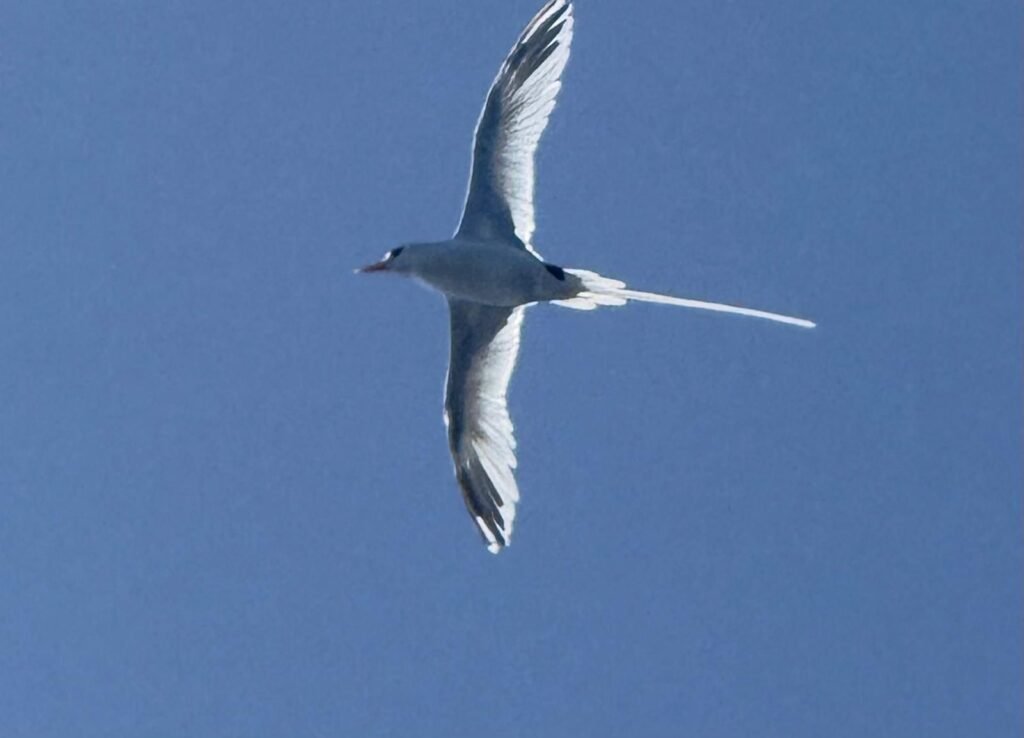
It’s such a treat having a forecast at the tip of your fingers. We bought Starlink, as many cruisers do, and, despite differing opinions of the creator, we have found it incredibly easy to use and a game changer in many ways. Communication to home (including the ability to see new grandchildren) is part of our wellbeing. Anna could talk to her partner, and Paul could keep tabs on his business. These were highlights during our passage. We didn’t see many boats/ships or wildlife. The occasional tropic bird squawked overhead showing its beautiful white plumage with an exotic long tail. A small black bird with a white tail bar has shown itself occasionally throughout the crossing, and more recently, a larger gannet-like bird circled us. Closer to land, the prehistoric looking silhouettes of frigate birds gave us company. Flying fish abound and we’ve had a couple of pods of dolphins visit us briefly. They were large and speckled.
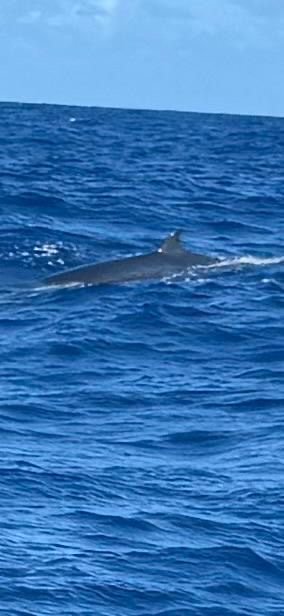
I set out on this crossing with three wishes. One of these was to see a whale. A mum and calf came to see us and swam next to the boat, alerting us to them with the long exhaling whoosh from their blow hole. They showed us their small dorsal fins twice then swam just sub-surface before swimming away. We trundled on downwind, now with 2 reefs in the main and a poled out reduced jib. Our progress was over 5 kt in 14 kt of wind. Despite messy seas, a good 24-hour run was 128 nm. The going was good. However, Christmas Day and Boxing Day (26 December for our non-British cousins) were forecast to be super light.
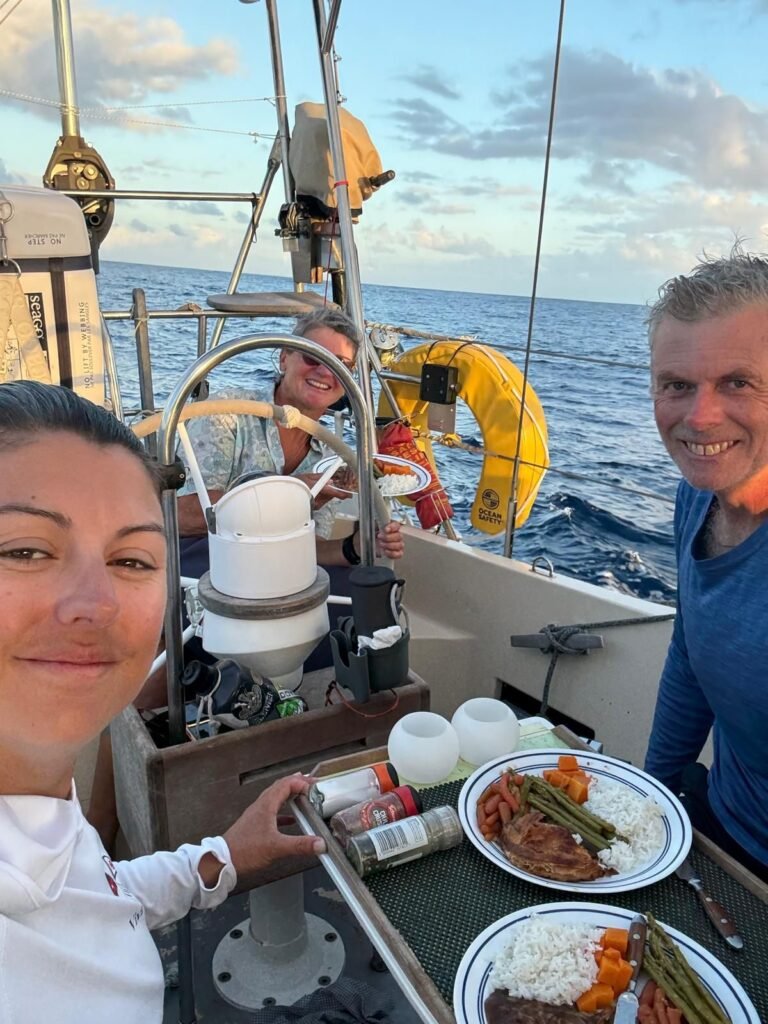
We have been struggling to keep up with our power demands, which aren’t excessive: fridge (with an old compressor), instruments, lights and comms, plus the water maker. We restricted the Starlink use. As the skies had been partially cloudy, the engine was running for an hour a day. Unfortunately, we have a fundamental problem with the water maker. The intake is too high (an original skin fitting) and when we rock, it sucks in air. These 2 days of motoring and light winds have meant the perfect water making conditions albeit hot with the engine running.
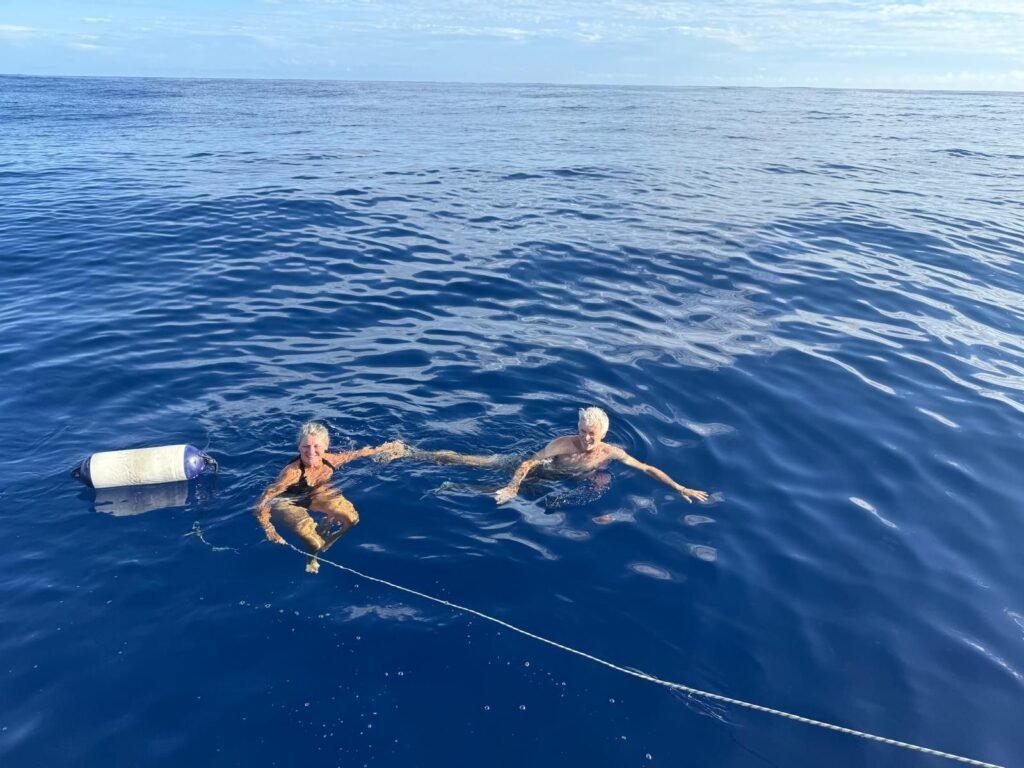
My second aim for this passage was to catch a fish. The mahi mahi I caught ticked that box, but it wasn’t quite the the tuna I had imagined! My third wish was to swim mid-Atlantic. Boxing Day saw us all take a brief dip, (not all at the same time of course), an exciting but scary activity thinking how deep 4000m is. The next day, I saw two Portuguese Man-o Wars; a sighting that made me glad we hadn’t waited an extra day to take our dip!! On the predawn of 26 December, we saw lights and passed a yacht within 100 metres, and it looked like it was drifting at 3 knots. It was certainly not the type of boat we would normally overtake. At 6am, they started sailing and disappeared over the horizon. Anna reckons that they had been sleeping off the excesses of Christmas day! Large ships are now becoming more common. We don’t have a radar onboard, but our radar reflector is an Echo-max Dual Band, designed to amplify the return signal, essentially making us look bigger than we are (a brilliant piece of safety equipment). On a couple of occasions during the day when we turned it on, a ship on a collision course with us altered course to avoid us!
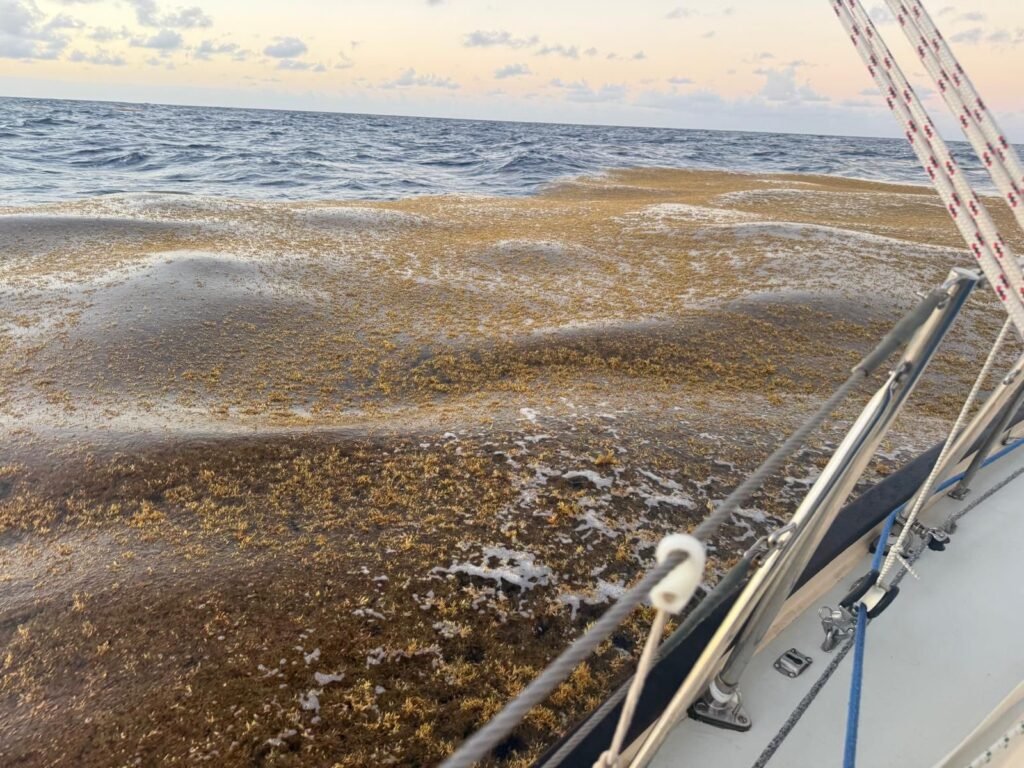
During our third week, life was not so physically demanding. The rolling wasn’t so severe although still present which made cooking and sleeping easier, but we now have the heat to contend with, but the warmth is welcome. Foul weather gear has been relegated to the hanging locker and the bruises are healing slowly. I find myself wishing for a change of view i.e. not the sky and waves and clouds relentlessly everywhere you looked. The smallest event is notable, such as a ship in the distance, a bird visiting us, orange peel floating past. I lost myself in a book but when I stopped reading and looked up, the same view was there! Sargassum weed makes it difficult to fish and the weed gets caught around our hydrovane rudder. I perfected the clearing technique of pushing down with the broom on the leading edge as far as I can reach, which isn’t the full depth of the rudder, but the weed slides off nonetheless. Anna wrote out a ‘countdown’ chart which raised our morale.
To encourage us to sail faster, Anna bought a plane ticket to Antigua from Barbados for 31 December. She has a romantic date with her partner (who became her fiancé) so is very keen to arrive in Barbados very soon. I know, Brian, deadlines!! The final day December 30 brought us clouds with 24 knots of wind and torrential rain. We rounded the north point of the island and headed south towards Port St. Charles. This final sting in the weather’s tail ensured our progress was fast enough to enable our early arrival on 30 December. We anchored as day was breaking. Anna is so excited to show us Caribbean anchorages with clear water and aquamarine views. In reality, the water was murky with debris floating around. Barbados had had two days of heavy rain which drained off the land bringing sediment with it. This didn’t spoil the elation of landfall and anchoring in a new place at all. A couple of days later, the water cleared to the expected gin-clear quality we are excited to see.
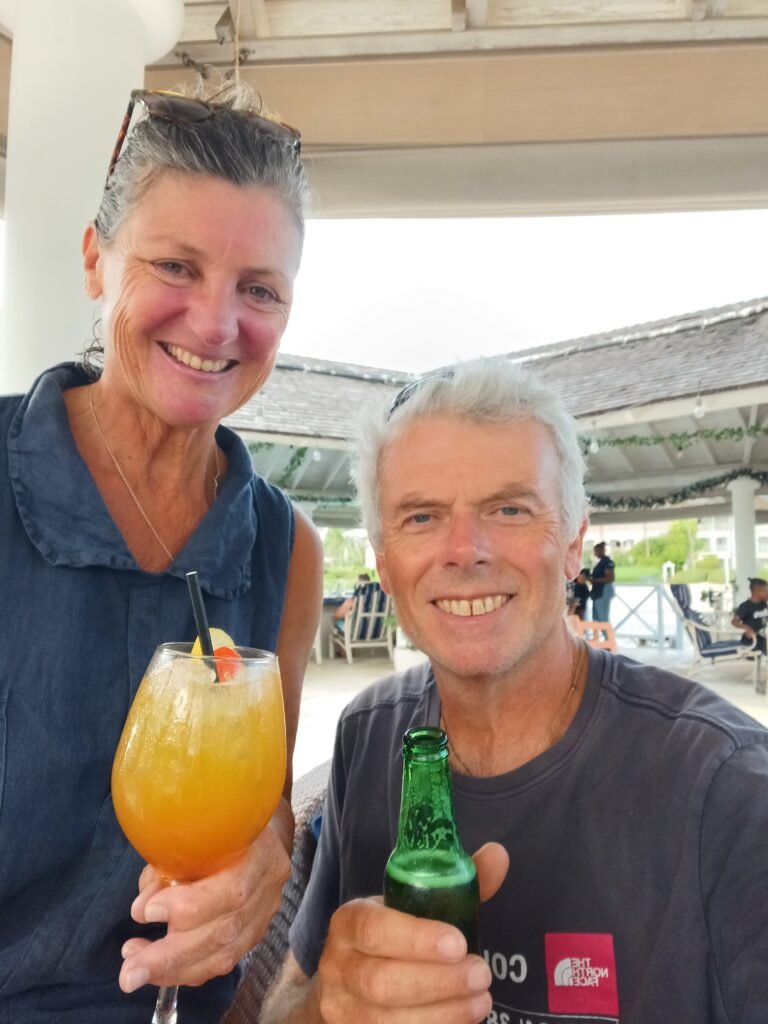
It took us several days to process what we had achieved and experienced. On talking to other female members of crew from a variety of different yachts, I have discovered that they are not keen on repeating the experience. I am in awe of the resilient ladies who spend the majority/all of their time on a boat, sometimes circumnavigating the earth. As for me, well the event is too recent to say if I will sail another transatlantic passage. I have been looking at prices to transport the boat home! Another season in the Caribbean is appealing but that doesn’t solve the problem of how to get ‘Skybird’ home afterwards. The memory is starting to fade now the crossing is a few months behind us. Maybe we will attempt the west-east passage. I do want to see the Azores. We have gained respect from many people we have met while working our way north up the Caribbean chain of islands. That makes me feel good so maybe we will ‘Go’ again. We never did learn how to take sun sights.
Passage report by Jo Masters, 12 October 2026
You must be logged in to post a comment.